

C4 Corvette Courtesy Lights Dimmer Module
Here’s a picture of the circuit board, heatsink removed –
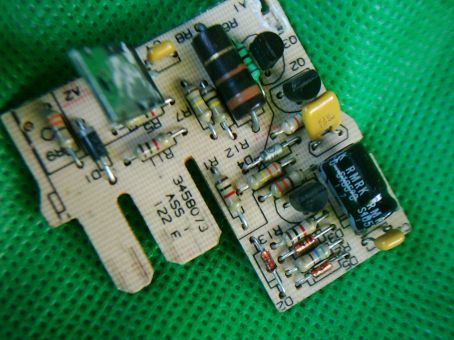
If your courtsey lights don’t go on when either door is opened, the dimmer module may have failed.
Signs that the module has failed are –
The hatch door switches don’t work, but the console hatch switch does.
The interior lights come on by turning the light switch but not when you open the door, or they may stay on all the time.
Test by grounding the thick white wire at the module – door hatch switches should work.
Check the black wire is connected to ground. If so, then dimmer module is not connecting these two wires together and making a circuit when the doors open.
Check that the dimmer is receiving a ground at the yellow wire when either door is open. (This yellow wire may be thin white for some years.)
The dimmer module is no longer available as a replacement part. Also one of the main electronic components is no longer available.
My module was fixed by an electronics expert who examined the circuit and found a suitable replacement part.
Here is all the info I have – I’ve listed most of the parts, in case it can help anyone else.
Location:
The dimmer module is in a small 2"x2"x.5" black plastic box, taped to the wiring loom behind the centre dash. (In my converted to Right Hand Drive vette, the module was midway behind the passenger crash pad.)
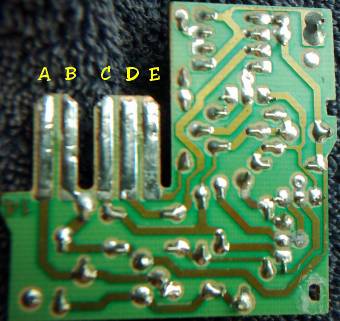
The module is wired –
"A" White wire goes to all of the lamps and supplies negative
"B" Black is Ground. Shorting White to Black will turn the lights on.
"C" Pink/White is 12 volts from the Ctsy/Clk fuse which is hot all of the time.
"D" 2 Yellow wires – (these may be white for some years) come from the Door switches. The switches close when the door is open and provides a ground on the Yellow (or white) wire/wires depending on what door is open.
"E" is the Reset signal used by the Delay Module to turn the Module off when you turn the ignition key to on. So the lights go off.
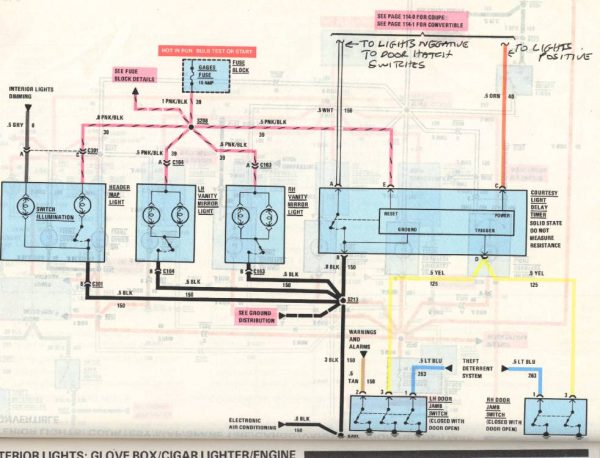
Here’s the circuit diagram in the GM Manual for my 88 Corvette.
The dimmer module is thin and the circuit is not very complicated –
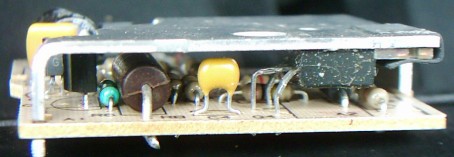
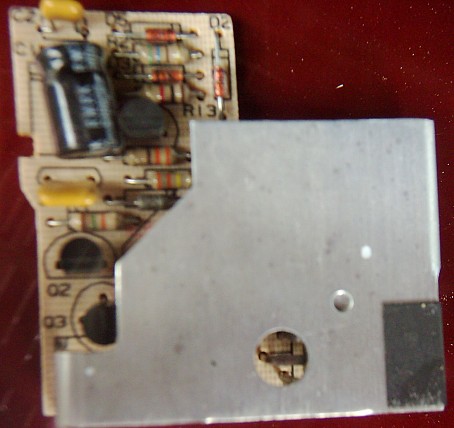
The metal piece is a heatsink on a large transistor.
The Transistor is in a TO 220 case, and in mine tested faulty.
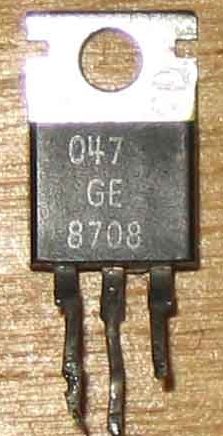
It’s no longer available.
Mine was replaced with an MJE 3055 and it worked again!!!!
I suspect that it fails because it takes the most heat/power. The heatsink begins to get warm to the touch within a few seconds.
A test of the amp draw showed my courtesy lights draw 2.8 amps and pressing the rear hatch release increased the draw momentarily to somewhere between 3 and 4 amps.
All parts in the module from my 1988 Coupe look brand new.
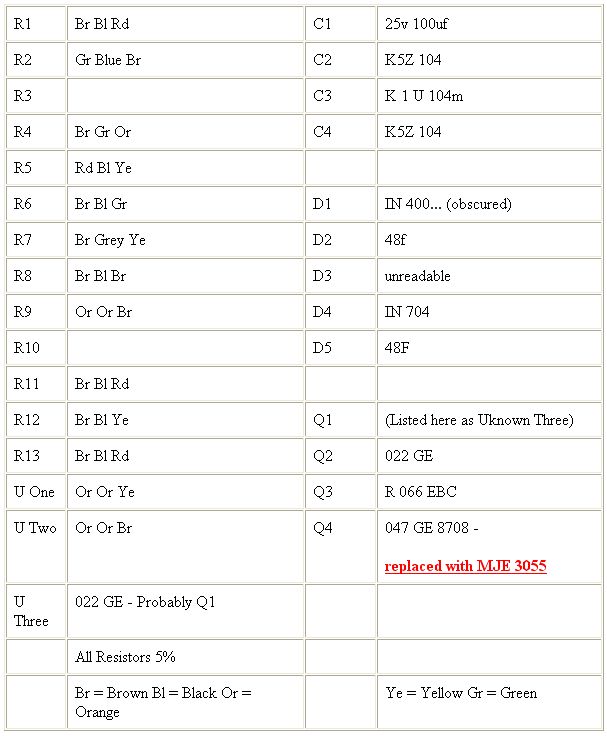
Here’s a parts list – only one signal diode was unreadable.
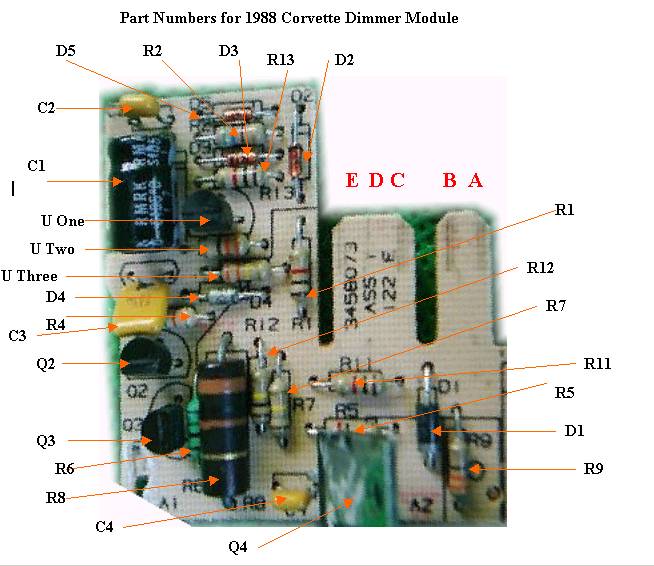
3 parts were not given a number so I’ve called them U (Unknown) One, Two, Three
Here is a diagram drawn up to work out how the circuit works –

A – to Lamps
B – To Battery negative
C – To Battery positive
D – To door switches ( a negative volts signal here will turn lights on, including a 15 seconds delay after low is removed)
E – to positive of dash lights ( a positive voltage signal here will turn lights off)
I hope the information here will help someone else repair their module – mine has been working since August 2005.

December 30th, 2009 at 1:10 am
Very nice blog, your article is interesting, i have bookmarked it for future referrence
January 28th, 2010 at 6:13 pm
Hey i loved the article.
I have a 1985 vette and the chevy dealer told me i need a new module but they dont make them anymore so i need another but i cant find one. so what do i do?
January 29th, 2010 at 8:37 am
@Blake – more than likely the Transistor in a TO 220 case is faulty – as pictured – they get very hot. Try replacing that.
All the info I have is here.
The other alternative might be to buy a dimmer kit from an electronics store like radio shack – must be 12 volt and able to handle say 4 amps to be safe.
March 14th, 2010 at 4:00 pm
Hey Rob it’s Rob, This article was very helpful to me also. I was able to get my dimmer module replacement from a Corvette Parts web site in the USA. The site is looking good. I hope you get a chance to play your keys once and a while.
June 23rd, 2010 at 10:09 am
hi, could you provide the phone num for the fellow who repaired yours thanks craig
June 23rd, 2010 at 10:47 am
@craig, sorry, he was a personal friend who is an electronics wizz -he provided the circuit diagram and worked out what nearly all of the parts are.
That info should help anyone with a little electronics knowledge fix the module.
More than likely it’s the large transistor, in the TO 220 case, they get hot when the doors are left open.
Mine now has a HUGE transistor there with large heatsink and I’ve had no further problems. I still am careful not leave the doors open when cleaning or fixing something without disconnecting the battery though. BTW I have seen mechanics leave the door open for an hour!!!
August 13th, 2010 at 12:09 pm
This page helped my fix my module in my 1984 Corvette , the problem was that there were no courtesy lights when opening the door , the light switch knob turned counterclockwise turned them all on , the hatch worked when the light switch was turned but not when it wasnt.
Problem was solved by replacing the GE transistor with a MJE 3055T , I also changed D1 IN4001 with IN4007 , this increases the allowed amperage to 7. This increased amperage will help with the burst amperage drawn when popping the hatch via the door switch.
All works now !!! Thank you for the transistor cross reference!
March 13th, 2011 at 6:48 am
I have found the same module is used in some commodores (not sure of year)it is located above steering column behind speedo it is usually just sitting there waiting to be unplugged
March 13th, 2011 at 10:25 am
Hi Geoff, that is very valuable info,thanks, My guess is that the year would be late 80’s, does that sound right ?
Do you know any other Holden parts that fit C4’s?
November 22nd, 2011 at 4:52 pm
The 1N4001 is a 50 volt, 1 amp diode.
The 1N4007 is a 1000 volt, 1 amp diode.
There is no difference in the current rating for the 1N4001 series of diodes.
October 20th, 2013 at 4:59 pm
RE
Leaving the doors open and the CTSY lights on for a long time overheats the light timer/driver module.
FIX: Place the HEADLIGHT/IP Lights/Map/CTSY light switch in the full counter clockwise direction. This bypasses the light timer/driver module and no more heated up module while you are working on your car.
Even if the light timer is defective and won’t supply a ground source for the CTSY lamps, they can be turned on with this switch because…..it bypasses the lamp timer/driver module.
You will have to remember to turn the switch out of the map/ctsy light position when you are finished working on the vehicle or it will drain the battery after a couple of days… unless you drive your car everyday.
C4C5C6
October 21st, 2013 at 8:48 am
That’s an excellent tip, thanks C4C5C6
December 26th, 2013 at 5:56 am
Can you tell me where the Delay Module is located in a 1994 Corvette PLEASE? The delay circuit is intermittent and has a negative affect on my after market alarm system.
Thank you,
June 2nd, 2014 at 10:29 am
Rob, was the pinout the same on the MJE 3055?
Thanks,
Doug
July 11th, 2014 at 5:41 am
I purchased the transistor at Radio Shack, it is a common part. TIP3055 NPN, TO-220 case. Radio Shack part number 276-2020. It will drop right in, no pin altering needed. I also replaced the diode right next to it. Works like a charm. Thanks for your help Rob. Be sure and visit the Corvette Museum if you ever come to the states.
July 11th, 2014 at 5:43 am
I almost forgot, conductive paste is a must, be sure and clean any old stuff off of the heat sink first.
January 29th, 2016 at 10:28 am
My ’94 Vette’s interior lights stay on when shutting the driver side door.I realize there is a delay but all interior lights stay lit.Is there a switch somewhere that was accidentally activated?Help!!!